Upwork is increasingly getting difficult — or so they say. I've had quite a number of friends who created an account and abandoned it, and others curious about whether it's worth starting. The conversation kept repeating itself so I decided to write this.
If the Internet tells you Upwork is a scam, understand what you are actually hearing: frustration from people who didn't make it, and silence from the thousands quietly building careers on the platform. People who are making money on Upwork eat quietly. The loudest voices are freelancers turned influencers who make money coaching you, and the disgruntled ones on Reddit whose complaints come wrapped in humble brags. "I have a $400k account but Upwork treated me like this." $400k is life-changing money — but if you break the rules, Upwork is judge, jury and executioner. Your account size doesn't matter.
The Numbers Behind The Noise
Upwork is not a startup hoping to find product-market fit. It is the dominant player in the freelance platform market.
Record full-year revenue of $788 million in 2025. Over $4 billion in gross services volume — that's the total amount clients spent on the platform in a single year. More than 18 million registered freelancers across 180+ countries. Around 800,000 active clients. Upwork holds roughly 61% of the freelance platform market share, more than triple Fiverr's and double Toptal's. Fast Company named them one of the Most Innovative Companies of 2025, and Frost & Sullivan gave them the Global New Product Innovation Award in 2023.
AI-related work on the platform grew 60% year-over-year in 2024, and freelancers working on AI projects earned 44% more per hour than those who didn't. The average freelancer hourly rate sits around $39. Web and software development accounts for 34% of all work on the platform.
Why does this matter to you? $4 Billion in circulation means this is not a dying marketplace. The money is real, the clients are real, and the opportunity is real. The question is whether you can position yourself to capture your slice of it.
1. Think People First
Before you get into the Upwork algorithm debate, start here: Who are the people on the other side of your proposals?
The client landscape has shifted. Three or four years ago, the typical Upwork client had money to spend, no time to look for talent, and needed an automated way to protect their interests. You saw people offering 3-year contracts at $40 an hour.
Since 2025, the attitude has changed. Everyone is looking to save. But not everyone is looking to save the same way. Here's how I break down the client tiers on Upwork right now:
The top-tier client understands the value of AI in speeding things up. He has money but is not willing to splash it on a slow freelancer. This client wants the best person on the job who can leverage AI to move fast, and can pay explosive amounts for it. Usually after the first successful job, these people will negotiate a long-term contract with a reliable freelancer. They don't sift through 150 proposals. They go to Upwork and say "find me someone who can do this" and the algorithm feeds them the best and boosted profiles. This is where Connects, profile optimisation and your Upwork ranking all come in.
The fair-price client says "I have this job, I have this amount, let's work." Expect fair treatment here. This kind of client appreciates honesty, communication and thoroughness. These are skills you should have or be actively improving.
The exploitative client knows the freelance labour market is full of desperate people right now. So he dangles a carrot. $50 for a hard job. Then he piles on responsibility knowing the developer will do it just to get good reviews. Upwork has documentation to help you handle this, but you need to recognise the pattern before you're already trapped.
The scammer. You have to beware of these. They will take you for everything you've got. Steal, use you, hack you or worse. Follow Upwork's guidelines on surviving scammers and go to the unofficial Upwork Reddit channel — r/Upwork. It's unhinged and town-square-like, but it will help you catch up fast with how scams are evolving.
Pro tip: Read The General Guide To Upwork Scams on Reddit
Once you know the people, you know who you need to become to be chosen. You can play the algorithm all you want, but on the other end of everything you type, there is a person who is as interested in gaining value and as afraid of losing money on bad product as you are.
Think people first. Upwork is a community brought together by the platform. The rules matter as much as the people they serve.
2. Play The Long Game But Work Hard On Your Short Plays
Freelancing is hard and competitive. Upwork, being the top platform, is even more competitive. Whether you are new or a seasoned freelancer looking to reinvent yourself: your patience will be tested and your persistence will be rewarded.
The long-term goal is being on a stable, well-paying contract. Being a top freelancer that Upwork recommends to its best clients. Getting paid consistently.
The mid-term goal is building up smaller, shorter contracts. Quick jobs. Building your skill set, networking, studying the market. You don't get to the long-term goal without passing through this one unless you are extremely lucky.
The immediate goal is your short plays. This is where the real work happens and where most freelancers give up too early.
In my experience, I got lucky in a sense — I got to Top Rated Plus with just 3 jobs. But those 3 jobs amount to 2,240+ hours. My takeaway: there is more value in sustaining a long-term business relationship than in chasing volume. Your mileage may vary, but there is no substitute for good work and maintaining good relationships.
As you improve your profile, think of every iteration of profile development as a play that must be analysed and improved. Every proposal is a data point that needs to be dissected and built on.
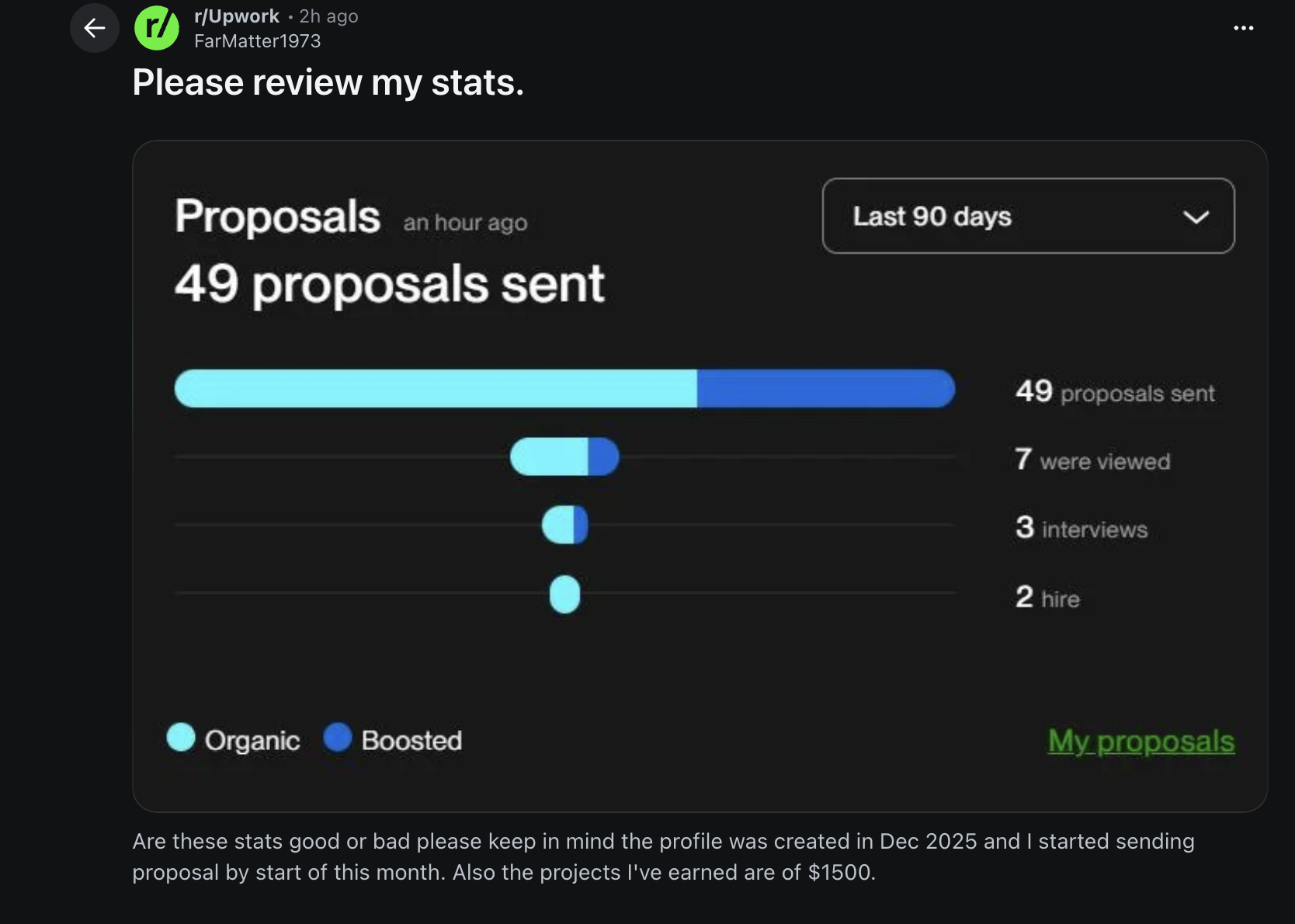 Source: r/Upwork
Look at this from r/Upwork. 49 proposals sent in 90 days. Only 7 were even viewed. 3 interviews. 2 hires. $1,500 earned in the first few months on the platform. This is what the grind looks like. Most of your proposals will disappear into the void. The game is making sure the ones that land are good enough to convert.
Read job posts. What skills are clients asking for? What's the overall application tone on key skills? It's all about patience, playing the long game and relentlessly looking to improve.
Right now, in most of the job posts I see, clients are prioritising freelancers who have an AI-first attitude. n8n, Agentic Workflows, Supabase, Firebase, Cursor, Antigravity top almost every post. These can be pointers but they can also get you panicking and chasing the wind. When you see trends like these you can either choose to be a generalist or a specialist. I chose to specialise. Depth beats breadth when a client scans 50 proposals and needs to trust that you've solved their exact problem before.
In the job posts, listen to what clients are saying about what they need. More importantly, listen to what they're saying about the freelancer they want to work with. Become that person.
Again. Think people first.
3. Follow The Rules
The most nerve-wracking moment in your Upwork journey will be right after a client says "Hey, I saw your proposal. I'm interested. Let's talk."
At this moment, your position must shift: DO NOT THINK PEOPLE FIRST. Think Upwork first.
Do not be hoodwinked. Your main concern shouldn't be what the other person is saying. It should be: what does Upwork say about this? For every response you send, you must consider the Upwork funnel and playbook.
Failure to do so will result in a ban. Back in the day the ban was effective immediately and non-negotiable, though this may be shifting since Upwork now shows you account health status.
Things to know: Upwork is ruthless on freelancers who share personal contact details before a contract is finalised. Clients who want to take the conversation off-platform before a contract is signed are a red flag. On top of that, you should also be able to negotiate boldly without putting yourself in the corner, all while studying your client for scammer patterns.
Have your own rules as a freelancer and follow them. Know Upwork's rules and follow them. Listen to the client's rules and expectations and see if you are prepared to follow them. This is the foundation of your Upwork survival journey.
The interview and contract negotiation phase is the most dangerous period of your freelance career. When you see people talking about how a single mistake cost them everything, this is the phase they're talking about. This is why the unofficial Upwork Reddit channel is a must-visit.
Protect yourself. Protect your account.
Last Word
How do you survive Upwork as a freelancer? This entire article can be distilled into one statement: Know and study the people on Upwork, and follow the rules.
Link to the You can also check the official Upwork subreddit, though it's much smaller than r/Upwork.
My name is Mxolisi Masuku. I write blogs like this and I have a newsletter called Systems For Humans where I talk about the software world beyond the technical considerations. For me, the software world works better when you think about who is on the other end as the guiding principle of whatever you are going to build. Subscribe and follow if you like this.